
How Life Sciences Companies in the Netherlands are Redesigning Operating Models for Scale

Introduction: Scale Is Where Good Life Sciences Companies Start to Struggle
Over the past few years, we have had countless conversations with leadership teams across the Netherlands life sciences ecosystem from fast-growing biotech scale-ups in Leiden and Utrecht to established pharma and MedTech organizations operating globally from Dutch hubs.
What we hear again and again is this:
We’re growing fast but everything feels harder than it should. Decisions take longer. Teams duplicate work. Leaders become bottlenecks and suddenly a business that once felt agile starts to feel heavy.
This is rarely a strategy problem. Almost always, it’s an operating model problem. In the Netherlands where life sciences companies are scaling faster, operating more globally and competing fiercely for specialized talent, operating models are now a strategic differentiator, not a back-office concern.
Growth vs Scale: A Distinction Many Dutch Life Sciences Companies Miss
One of the biggest misconceptions we see is treating growth and scale as the same thing.
They’re not.
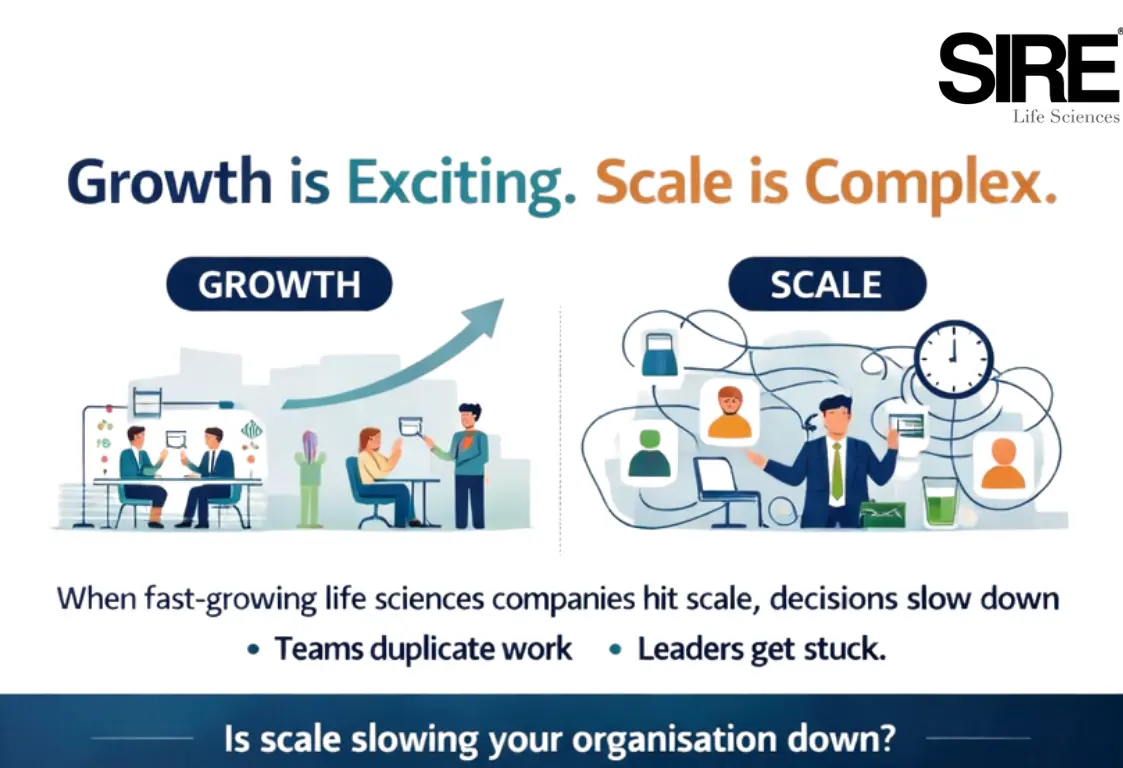
Growth Is About Volume
You add:
- More projects
- More people
- More partners
- More markets
Scale Is About Complexity
You introduce:
- More dependencies
- More handovers
- More decision layers
- More pressure on leadership
An operating model that works brilliantly at 150 people in a Dutch biotech often starts to break down at 400 even if revenues are strong.
That’s not failure. That’s physics.
Why Operating Models Break at Scale in Life Sciences
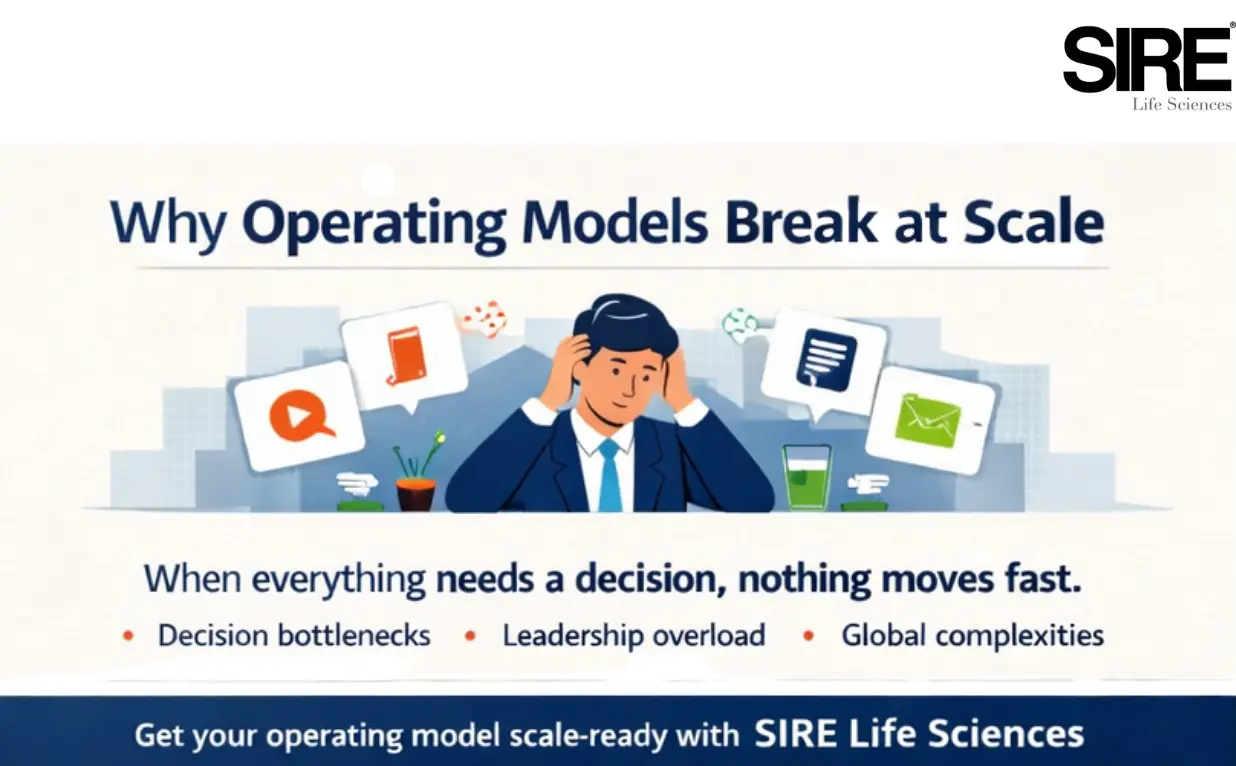
In the Netherlands life sciences sector, operating model strain shows up in very specific ways.
Common Signals I See in the Market
- Leadership teams pulled into operational decisions daily
- Global teams unclear on who owns what
- Functions optimizing locally but slowing the whole system
- Talented people frustrated by unclear priorities
Most companies respond by restructuring. That’s usually the wrong first move.
The Real Reason Most Operating Model Redesigns Fail
From our experience at SIRE® Life Sciences, operating model redesigns fail for one core reason:
They start with structure instead of decisions.
Companies jump straight to:
- Reporting lines
- Org charts
- Centralization vs decentralization debates
But structure doesn’t create speed, decision clarity does.
In nearly every successful scale story we have seen, leadership first got brutally clear on which decisions matter most and who truly owns them. Only then did structure follow.
What the Big Consultancies Get Right and Where They Stop Short
Articles from EY, McKinsey and PwC rightly rank high because they:
- Frame operating models as strategic
- Speak the language of CEOs and boards
- Acknowledge complexity and uncertainty
Where they fall short is execution.
They rarely answer:
- What should leadership do first?
- How do you redesign without slowing the business?
- How do people and capabilities really fit into the model?
That gap is exactly where many Dutch life sciences companies struggle.
A Scale-Ready Operating Model: The SIRE® Life Sciences Perspective
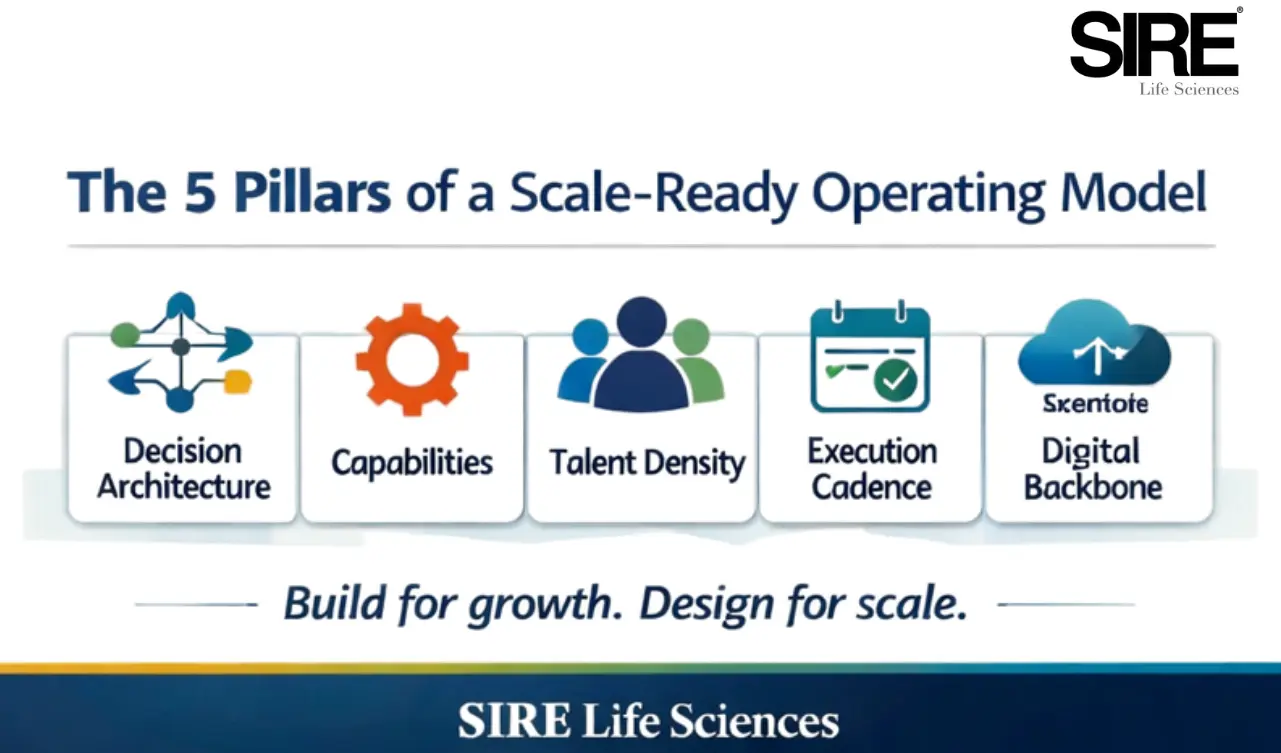
Based on what we see across pharma, biotech, MedTech and innovation-driven organizations in the Netherlands, a scale-ready operating model rests on five pillars.
1. Decision Architecture Comes First
Before structure, ask:
- Which decisions truly drive value at scale?
- Which decisions must move fast?
- Which ones can be standardized?
If decision rights are unclear, no operating model will work.
2. Capability-Led Design (Not Function-Led)
Scaling organizations must identify:
- What capabilities differentiate us?
- Where do we need deep expertise?
- Where does good enough suffice?
This prevents overbuilding teams and protects speed.
3. Talent Density Over Headcount
In the Netherlands talent is scarce, not cheap.
High-performing operating models focus on:
- Fewer layers
- Stronger leaders
- Clear accountability
Adding people without redesigning accountability is one of the fastest ways to slow down.
4. Execution Cadence, Not More Governance
Scale requires rhythm.
Strong operating models define:
- How often decisions are reviewed
- Where issues escalate
- When leadership intervenes and when they don’t
This reduces noise and increases focus.
5. Digital as the Backbone, Not the Add-On
Digital tools should:
- Create visibility
- Reduce manual work
- Support faster decisions
If digital systems don’t reinforce the operating model, they create friction instead of leverage.
A Practical Roadmap: How to Redesign an Operating Model for Scale
Here’s a step-by-step approach we often use with Dutch life sciences organizations.
Step 1: Diagnose Where Scale Is Breaking
Look for:
- Decision bottlenecks
- Duplication across teams
- Leadership overload
Step 2: Redesign Critical Decisions
Clarify:
- Ownership
- Inputs
- Escalation paths
Step 3: Align Capabilities and Talent
Ensure the right expertise sits where decisions are made.
Step 4: Redesign Structure (Only Now)
Structure should support:
- Speed
- Accountability
- Clarity
Step 5: Stress-Test for Growth and Change
Ask:
- Would this still work with double the portfolio?
- What happens if leadership changes?
If the model survives those questions, it’s likely scale ready.
Measuring Success: KPIs Most Companies Forget
Operating model redesign isn’t about elegance, it’s about outcomes.
Key indicators I encourage leaders to track:
- Time-to-decision
- Speed-to-market
- Leadership span effectiveness
- Cost-to-serve per asset
- Talent productivity ratios
If these improve, the operating model is working.
What Successful Scale Leaders in the Netherlands Do Differently
Across the Dutch life sciences sector, the most effective leaders:
- Design backwards from outcomes
- Accept imperfection in favor of resilience
- Invest early in leadership capability
- Treat operating model evolution as continuous
The goal isn’t to design the perfect model. It’s to build one that absorbs pressure without breaking.
The Future of Operating Models in Dutch Life Sciences
Looking ahead, I see operating models becoming:
- More modular
- Less hierarchical
- More capability-driven
- Continuously refined rather than redesigned
The organizations that win will treat operating models as a leadership discipline, not a one-off initiative.
Final Thoughts: Operating Models Are Now a Leadership Responsibility
In the Netherlands life sciences industry scale is no longer optional, it’s expected and scale exposes everything.
Redesigning your operating model isn’t about control.
It’s about creating clarity, speed and resilience so your people can do their best work.
FAQ’s
What is an operating model in life sciences?
An operating model defines how a life sciences organization makes decisions, deploys talent and executes strategy across functions and markets.
Why do operating models often fail during scale-up?
They fail because decision rights, capabilities and leadership structures are not redesigned to handle increased complexity.
When should a life sciences company redesign its operating model?
An operating model should be redesigned when growth starts slowing decisions, creating duplication or overloading leadership.
Is the operating model redesign only about restructuring teams?
No it is primarily about clarifying decisions, aligning capabilities and enabling talent to perform at scale.
Who should be involved in operating model redesign?
CEOs, HR leaders, hiring managers and procurement stakeholders must collaborate to ensure the model supports both strategy and talent needs.
Call to Action: Let’s Talk About Where Scale Is Breaking for You
If you’re a:
- HR Director
- Talent Acquisition leader
- Hiring Manager
- Purchasing or Procurement leader
- CEO or executive leader
…and you feel scale is starting to slow your organization down, now is the moment to act.
Book a confidential conversation with SIRE® Life Sciences to explore how your operating model can better support growth, talent and long-term performance in the Dutch life sciences market.
Because operating models don’t fail overnight, they fail quietly until leadership chooses to address them.